A Round Worth Making: Social Refreshment in Hybrid South West Teams
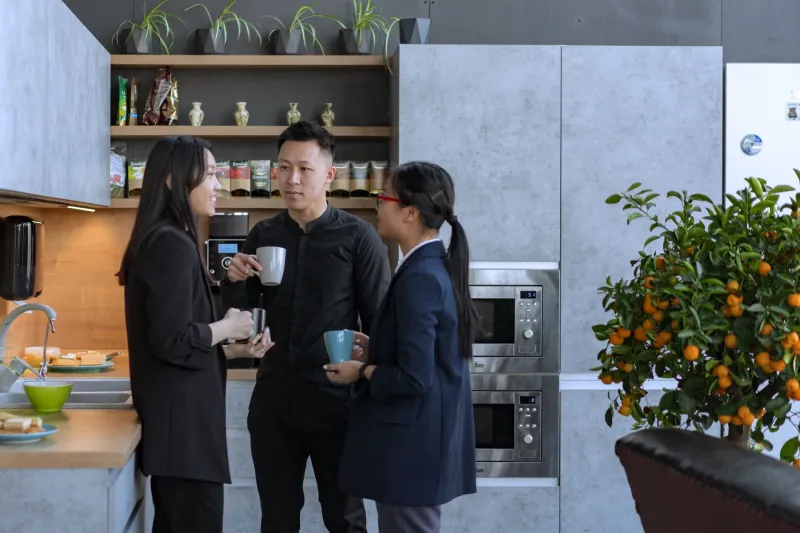
Hybrid working has not removed the office kitchen from working life, but it has changed the company it keeps. On many South West sites, the mid-morning kettle run now happens in smaller clusters, at less predictable times, and often among people who already know one another well. The tea round, once a dependable piece of informal coordination, has become easier to skip. That matters less for the tea itself than for what the ritual quietly did: it created a low-stakes reason for people to pause, notice who was present and exchange the kind of information that rarely surfaces in a scheduled meeting.
For organisations across the region, from Bristol city-centre studios to Plymouth marine businesses, rural Devon offices and Bath's visitor-facing venues, the challenge is not to force a return to old habits. It is to design refreshment provision that makes shared moments easier to sustain in a working pattern that is here to stay.
Why a small ritual carries weight
The tea round is often treated as a piece of office folklore, but it performs several practical functions. It distributes attention: the person who asks whether anyone wants a drink is briefly scanning the room for who is present and who may need support. It creates permission to pause without a formal break being declared. It also gives newer colleagues a simple way to join a group without having to interrupt a meeting or manufacture a reason to speak.
In distributed teams, those small exchanges are harder to replicate online. A video call can carry a planned check-in, but it rarely produces the unplanned aside that begins with someone waiting for the kettle. The result is not a crisis, but a gradual thinning of social glue. Managers may notice it as quieter offices, fewer cross-team conversations or new starters taking longer to settle in.
What hybrid working disrupted
The traditional round depended on density and habit. When most of a team arrived at roughly the same time and sat within sight of one another, the round organised itself. Hybrid patterns break that rhythm. One part of a team may be in on Tuesday, another on Thursday, and a third working from home across the week. Hot-desking adds further variation, because people no longer have a predictable base from which to make an offer.
South West organisations also face practical geography. Some teams are spread across multiple sites, and rural locations can mean longer journeys and less spontaneous contact. In those settings, the refreshment moment needs to be deliberate enough to survive, but light enough that it does not feel like another corporate initiative.
Reintroducing the ritual without mandating attendance
The quickest way to kill a social ritual is to make it compulsory. A refreshment culture works best when it is opt-in, repeatable and visibly low-effort. Rather than announcing a fixed social hour, organisations can attach a short refreshment window to something people already attend: a team briefing, a project handover or a monthly update. A twenty-minute pause after the formal part of the meeting gives people a reason to stay without requiring them to arrange a separate event.
Ownership matters. A rotating refreshment host, chosen voluntarily, can make sure the kettle is on, the milk is in stock and the invitation is open. The role should be small and shared, not another administrative burden. In teams with remote colleagues, the host can also decide whether to open a simple video link for a few minutes, but remote participation should be an option rather than an expectation.
Equipment and stocking choices that lower the threshold
The physical setup often determines whether a ritual survives. If making a drink involves hunting for a clean mug, discovering the milk has run out or waiting for a slow kettle, people will drift away. Organisations should treat the refreshment point as a working facility, not a decorative afterthought.
Useful measures include adequate hot water capacity for the team's peak arrival times, a reliable supply of clean crockery, clear storage for tea, coffee and alternatives, and a simple system for milk and chilled items. In smaller satellite offices, a compact hot water tap or an efficient kettle may be more sensible than a large machine that is rarely used. In shared or guest-facing spaces, the priority shifts to keeping the offer tidy and consistently stocked.
Stocking should reflect actual attendance patterns. Smaller, more frequent orders often work better than bulk buying in hybrid workplaces, particularly for perishable items. Shelf-stable alternatives and a modest range of dietary options help ensure that the invitation is genuinely open. None of this needs to be elaborate. The aim is to remove friction, not to create a café.
Scheduling and team-level ownership
A refreshment ritual should belong to the team, not to a central policy. Team leaders can agree a simple rhythm: perhaps a Tuesday morning round after the weekly briefing, or a Thursday afternoon pause for project teams that are usually on site. The rhythm should be reviewed when attendance patterns change, and it should not be treated as a performance measure.
It also helps to separate the social moment from the task list. If the refreshment window becomes a second meeting, people will treat it as work and disengage. The host's job is to create the conditions, not to programme the conversation.
Signs that it is working
The evidence of a healthy refreshment culture is usually informal. People linger after meetings. New starters are included without being formally introduced. Cross-team queries surface in the kitchen rather than waiting for a calendar slot. The office does not need to be full for these signs to appear; it needs to have enough shared moments for them to occur naturally.
Organisations reviewing provision in 2026 should resist the temptation to measure success by attendance alone. A better test is whether the refreshment point feels used, maintained and open. If it does, the tea round is not a lost art. It is simply a habit that has been given a sensible place to restart.